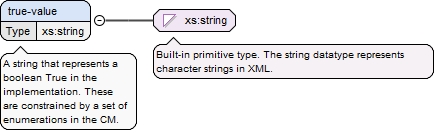
A string that represents a boolean True in the implementation.
These are constrained by a set of enumerations in the CM.
Diagram
Type
xs:string
Properties
content
simple
Source
<xs:element name="true-value" type="xs:string"><xs:annotation><xs:documentation xml:lang="en-us">A string that represents a boolean True in the implementation. These are constrained by a set of enumerations in the CM.</xs:documentation><xs:appinfo><rdf:Description rdf:about="https://semanticdatacharter.com/ns/sdc4/sdc4.xsd#XdBooleanType/true-value"><rdfs:domain rdf:resource="https://semanticdatacharter.com/ns/sdc4/sdc4.xsd#XdBooleanType"/><rdfs:range rdf:resource="http://www.w3.org/2001/XMLSchema#string"/><rdfs:label xml:lang="en-us">true-value</rdfs:label><rdf:type rdf:resource="http://www.w3.org/2001/XMLSchema#string"/><rdfs:comment xml:lang="en-us">A string that represents a boolean True in the implementation. These are constrained by a set of enumerations in the CM.</rdfs:comment></rdf:Description></xs:appinfo></xs:annotation></xs:element>
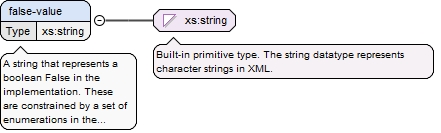
A string that represents a boolean False in the implementation.
These are constrained by a set of enumerations in the CM.
Diagram
Type
xs:string
Properties
content
simple
Source
<xs:element name="false-value" type="xs:string"><xs:annotation><xs:documentation xml:lang="en-us">A string that represents a boolean False in the implementation. These are constrained by a set of enumerations in the CM.</xs:documentation><xs:appinfo><rdf:Description rdf:about="https://semanticdatacharter.com/ns/sdc4/sdc4.xsd#XdBooleanType/false-value"><rdfs:domain rdf:resource="https://semanticdatacharter.com/ns/sdc4/sdc4.xsd#XdBooleanType"/><rdfs:range rdf:resource="http://www.w3.org/2001/XMLSchema#string"/><rdfs:label xml:lang="en-us">false-value</rdfs:label><rdf:type rdf:resource="http://www.w3.org/2001/XMLSchema#string"/><rdfs:comment xml:lang="en-us">A string that represents a boolean False in the implementation. These are constrained by a set of enumerations in the CM.</rdfs:comment></rdf:Description></xs:appinfo></xs:annotation></xs:element>
Complex Type sdc4:XdBooleanType
Namespace
https://semanticdatacharter.com/ns/sdc4/
Annotations
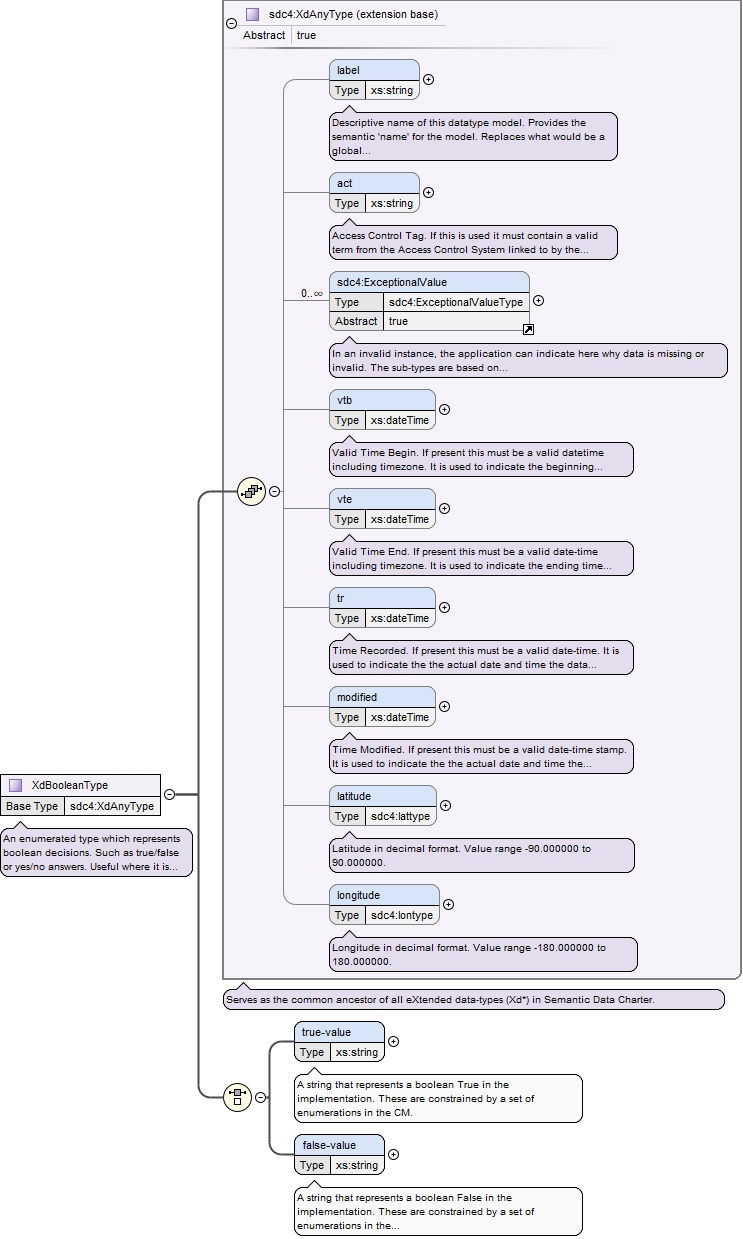
An enumerated type which represents boolean decisions.
Such as true/false or yes/no answers. Useful where it is essential to devise the meanings
(often questions in subjective data) carefully so that the only allowed result values result
in one the options; true or false but are presented to the user as a list of options.
The possible choices for True or False are enumerations in the DM.
The reference model defines 'true-value' and 'false-value' in an xs:choice so only one or the
other may be present in the instance data.

The XdBooleanType should not be used as a replacement for enumerated choice types such as male/female,
or similar choice sets. Such values should be modeled as XdStrings with enumerations and may reference
a controlled vocabulary. In any case, the choice set often has more than two values.

The elements, 'true-value' and 'false-value' are contained in an xs:choice and only one or the other is
instantiated in the instance data with its value coming from the enumerations defined in a Data Model.
<xs:complexType name="XdBooleanType"><xs:annotation><xs:documentation xml:lang="en-us">An enumerated type which represents boolean decisions. Such as true/false or yes/no answers. Useful where it is essential to devise the meanings (often questions in subjective data) carefully so that the only allowed result values result in one the options; true or false but are presented to the user as a list of options. The possible choices for True or False are enumerations in the DM. The reference model defines 'true-value' and 'false-value' in an xs:choice so only one or the other may be present in the instance data. The XdBooleanType should not be used as a replacement for enumerated choice types such as male/female, or similar choice sets. Such values should be modeled as XdStrings with enumerations and may reference a controlled vocabulary. In any case, the choice set often has more than two values. The elements, 'true-value' and 'false-value' are contained in an xs:choice and only one or the other is instantiated in the instance data with its value coming from the enumerations defined in a Data Model.</xs:documentation><xs:appinfo><rdf:Description rdf:about="https://semanticdatacharter.com/ns/sdc4/sdc4.xsd#XdBooleanType"><rdfs:isDefinedBy rdf:resource="https://semanticdatacharter.com/docs/sdc4/sdc4_xsd_Complex_Type_sdc4_XdBooleanType.html#XdBooleanType"/><rdfs:subClassOf rdf:resource="https://semanticdatacharter.com/ns/sdc4/sdc4.xsd#XdAnyType"/><rdfs:label xml:lang="en-us">XdBooleanType</rdfs:label><rdf:type rdf:resource="https://semanticdatacharter.com/ns/sdc4/sdc4/CMC"/><rdfs:comment xml:lang="en-us">An enumerated type which represents boolean decisions. Such as true/false or yes/no answers. Useful where it is essential to devise the meanings (often questions in subjective data) carefully so that the only allowed result values result in one the options; true or false but are presented to the user as a list of options. The possible choices for True or False are enumerations in the DM. The reference model defines 'true-value' and 'false-value' in an xs:choice so only one or the other may be present in the instance data. The XdBooleanType should not be used as a replacement for enumerated choice types such as male/female, or similar choice sets. Such values should be modeled as XdStrings with enumerations and may reference a controlled vocabulary. In any case, the choice set often has more than two values. The elements, 'true-value' and 'false-value' are contained in an xs:choice and only one or the other is instantiated in the instance data with its value coming from the enumerations defined in a Data Model.</rdfs:comment></rdf:Description></xs:appinfo></xs:annotation><xs:complexContent><xs:extension base="sdc4:XdAnyType"><xs:choice maxOccurs="1" minOccurs="1"><xs:element name="true-value" type="xs:string"><xs:annotation><xs:documentation xml:lang="en-us">A string that represents a boolean True in the implementation. These are constrained by a set of enumerations in the CM.</xs:documentation><xs:appinfo><rdf:Description rdf:about="https://semanticdatacharter.com/ns/sdc4/sdc4.xsd#XdBooleanType/true-value"><rdfs:domain rdf:resource="https://semanticdatacharter.com/ns/sdc4/sdc4.xsd#XdBooleanType"/><rdfs:range rdf:resource="http://www.w3.org/2001/XMLSchema#string"/><rdfs:label xml:lang="en-us">true-value</rdfs:label><rdf:type rdf:resource="http://www.w3.org/2001/XMLSchema#string"/><rdfs:comment xml:lang="en-us">A string that represents a boolean True in the implementation. These are constrained by a set of enumerations in the CM.</rdfs:comment></rdf:Description></xs:appinfo></xs:annotation></xs:element><xs:element name="false-value" type="xs:string"><xs:annotation><xs:documentation xml:lang="en-us">A string that represents a boolean False in the implementation. These are constrained by a set of enumerations in the CM.</xs:documentation><xs:appinfo><rdf:Description rdf:about="https://semanticdatacharter.com/ns/sdc4/sdc4.xsd#XdBooleanType/false-value"><rdfs:domain rdf:resource="https://semanticdatacharter.com/ns/sdc4/sdc4.xsd#XdBooleanType"/><rdfs:range rdf:resource="http://www.w3.org/2001/XMLSchema#string"/><rdfs:label xml:lang="en-us">false-value</rdfs:label><rdf:type rdf:resource="http://www.w3.org/2001/XMLSchema#string"/><rdfs:comment xml:lang="en-us">A string that represents a boolean False in the implementation. These are constrained by a set of enumerations in the CM.</rdfs:comment></rdf:Description></xs:appinfo></xs:annotation></xs:element></xs:choice></xs:extension></xs:complexContent></xs:complexType>