Pick components
Most pilots assume the modeling is the heavy work. For most domains, the components already exist.
Public component libraries on SDCStudio
SDCStudio ships with read-only public libraries that any project can reference directly. The libraries cover the domains most pilots actually care about, plus the standards-anchored ProvGov layer the audit observes. Production deployment is on Google Cloud Run, currently v4.1.0, at sdcstudio.axius-sdc.com.
Domain libraries: what your records are
Pick the one that matches your vertical. These describe the entities your decision flow handles.
NIEM Foundation
1,606 components from the NIEM 6.0 model, Core and six domains
National Information Exchange Model. The federal interoperability vocabulary. State, local, and federal agencies and their downstream consumers already speak this language.
FHIR Clinical
321 components, FHIR R4 clinical resources
If you are in healthcare, your data already needs to map to FHIR. The library makes the mapping a reference, not a translation exercise.
NIH CDE
353 NIH-endorsed Common Data Elements
Research and clinical-trial work where instrument-level standardization matters. Sourced from the NIH portfolio.
Default Library
111 general components
General data structures: people, organizations, transactions, addresses, identifiers, common business entities. The starting point when no vertical library applies cleanly.
ProvGov components: what makes the records governable
Domain components describe the entities. The 624 ProvGov components carry the governance evidence the audit actually observes: who did what, when, under what authority, with what classification, with what tamper-evident hash chain. Each family is anchored to a public standard and layers onto your domain model rather than replacing it.
Workflow States
W3C SCXML
Ordered state machines: document lifecycle, record intake, incident response, regulatory filing.
Provenance
W3C PROV-O, Activity Streams 2.0
System identifier, activity type, start and end timestamps, location. Maps to SDC4 AuditType.
Attestation
W3C Verifiable Credentials 2.0
Authority assertion, proof, delegation scope, committed timestamp. Maps to SDC4 AttestationType.
Party and Role
SDC4 PartyType, ParticipationType
Identity, organization, participation function (authorizer, reviewer, subject, provider, processor), mode.
Decision Tables
OMG DMN
Risk score, classification, actor role, severity, legal hold. The condition inputs and outcomes the DMN engine reads.
Retention
W3C DPV
Most-recent + hash, last N records, or full chain. Plus retention justification for regulatory defensibility.
Validation Hashes
SDC4 XdFileType
SHA-256 entity-state-before and entity-state-after hashes. Make the provenance chain tamper-evident.
Access Control Tags
W3C DPV
Public, Internal, Restricted, Confidential classifications, plus consent-required and access-expiry signals.
How the two layers compose
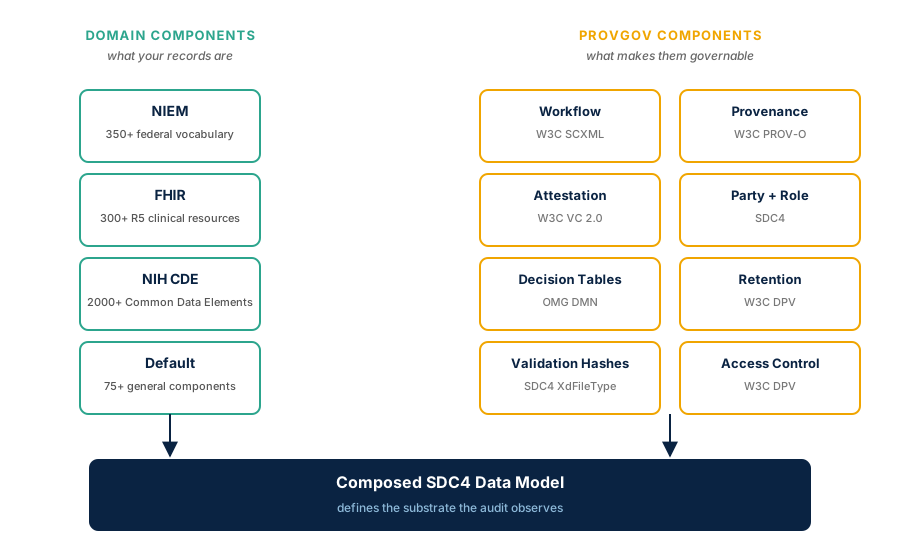
A worked example
A pilot model for a regulated approval flow typically pulls a Party entity from NIEM or Default, an event or encounter from FHIR or NIEM, then layers ProvGov on top: Provenance for who-did-what-when, Attestation for authority, Party and Role for the participation, Decision Table inputs for the rule the flow evaluates, Validation Hashes for tamper evidence, and Access Control Tags for classification. The Receipts the audit produces reference all of it.
Three usage patterns
- Reference: pull a component into your model as-is, no edits. Standards alignment becomes a property of using the right component.
- Copy and Modify: copy a component into your private project and customize it. Use this when a public component is 80% right and you need vertical-specific extensions.
- Create Custom: build from scratch. Reserved for cases where nothing in the libraries fits, which is rarer than most teams assume going in.
The reuse syntax
Components are referenced inside your model using a Markdown-template style. Domain and ProvGov components use the same syntax:
The component is bound to its provenance. Standards compliance is automatic when you compose from standards-aligned components, and the two layers compose cleanly because they were designed to.
What this means for the pilot
For a 30-day audit pilot, this is the difference between "we need to model our domain first" and "we picked four components on Monday and the agent had instances by Tuesday." Most pilots do not need a single custom component to start.
The decision flow you want to audit almost certainly involves entities (people, organizations, transactions, clinical events, claims) that the libraries already cover. Pick the library that matches your vertical, log into SDCStudio, create a private project, and compose the components you need.
Credits reminder
SDCStudio is paid for with credits, bought in advance at 1,000 credits per US dollar. Most pilot projects spend fewer than 20,000 credits ($20 worth) across the full audit period. Buy credits before pointing the agents at your data sources so the introspection step does not stall mid-run.