Pilot Pattern
The 30-Day SDC Audit
Start owning your data governance without replacing the platform you already run. A procurement-defensible pilot with zero production impact, a board-readable deliverable, and an empirical exit at day 30.
The procurement frame
For an organization locked to a platform it cannot easily leave, the hardest question is where to even begin. The answer is not a migration. It is a 30-day audit that runs alongside what you already have and leaves you owning a portable, open-standards record of your own governance. Because it runs in parallel and commits you to nothing, it also clears the usual procurement objection.
The most common procurement objection to SDC is not technical and is not pricing. It is the fear of a six-month commitment ending in a disrupted production system and nothing to show for it.
Both halves of that fear are misplaced. The smallest viable SDC pilot takes 30 days, runs in parallel with production, and produces a deliverable a board can read.
The cost is engineer time for setup, typically one to two days, plus the audit at day 30. There is no vendor lock-in: sdcgovernance is Apache 2.0 on PyPI and runs anywhere Python runs. There is no data migration: the audit observes the decision flow you already have. There is no system replacement: sdcgovernance runs alongside production, not in it.
SDCStudio's generated artifacts are yours to keep. At the end of the on-ramp you download the composed data model, a template SDC4 instance, and an Apache 2.0 app stack scaffolded for the stack profile you pick: a fully FOSS profile (Apache Jena/Fuseki + PostgreSQL), an Enterprise profile (Graphwise GraphDB + SirixDB + Keycloak), or both. Every later app you generate imports into the original stack, so infrastructure is procured once across the portfolio rather than per pilot.
The technology overview
Where SDCStudio fits, what the generated app stack contains, and how sdcgovernance reads from the knowledge graph to emit the Receipt corpus.
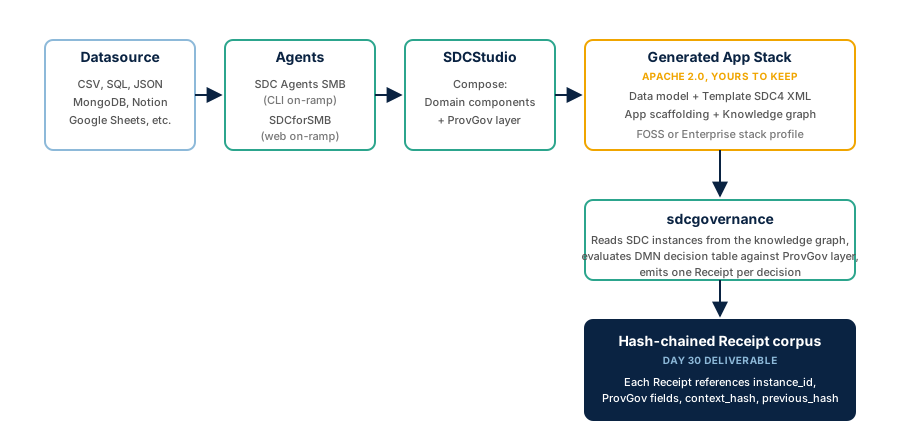
What the pilot actually does
Set up the substrate
Pick a domain library (NIEM, FHIR, NIH CDE, Default), layer the ProvGov components on top, point an agent at one datasource, get validated SDC4 instances. One to two days for most pilots.
Install sdcgovernance
pip install sdcgovernance. Configure the DMN decision table that mirrors the rules your decision flow already follows.
Observe for 30 days
Every decision in the flow generates a tamper-evident Receipt. Hash-chained. Bound to the SDC instance that produced it. Read-only against your existing system.
Read the corpus
Three questions: complete provenance, gaps, would-have-been-refused. Either you exit with documented governance or with a specific Phase 2 scope.
Why this works as a pilot
Zero production impact
sdcgovernance runs alongside, not in. Receipts are observational. Nothing the existing system does changes.
Defined exit criteria
At day 30 you have a Receipt corpus. The exit is empirical, not narrative.
Procurement-defensible
No vendor lock-in. No data migration. No system replacement. sdcgovernance is Apache 2.0, so there is no license or contract with Axius SDC to run the pilot. The only two costs are a minimal SDCStudio account (typically under 20,000 credits, $20 worth) and your own team's time.
Auditable artifact
The Receipt corpus is a board-readable deliverable. Hash-chained, structurally consistent, portable.
The substrate prerequisite, named honestly
sdcgovernance evaluates DMN decision tables against SDC instances and reads governance evidence from the ProvGov layer inside those instances. The Receipts it produces reference instance_id and instance_version on every decision, plus the provenance, attestation, party, and entity-state hashes the ProvGov components carry. The substrate is what gives the audit something to point at.
An SDC instance composed for governance has two component layers: domain (what the records are) and ProvGov (what makes them governable). Both ship as public libraries on SDCStudio. The substrate setup used to mean a modeling sprint. It does not anymore. Three affordances have collapsed that work into something a small team can complete in a day or two before the audit period begins.
Public Component Libraries
Domain: Default (75+), NIEM (350+), FHIR Clinical (300+), NIH CDE (2000+). ProvGov: workflow, provenance, attestation, party and role, decision tables, retention, validation hashes, access control. Pilots compose, not model.
SDC Agents SMB
pip install sdc-agents-smb. Eight agents. Local Ollama. CLI on-ramp.
SDCBench
Desktop canvas. A domain expert reuses published components and sketches the rest in plain language, then hands a draft to a modeler. No reference-model knowledge required.
The full guide
1. Prerequisites
What "running on SDC" actually means. SDCRM, instances, the substrate-and-monitor architecture made visible.
2. Pick components
The public libraries on SDCStudio across both layers: domain (NIEM, FHIR, NIH CDE, Default) and ProvGov (provenance, attestation, party and role, decision tables, retention, validation hashes, access control).
3. Your on-ramp
SDC Agents SMB. Eight agents, one terminal session, from an existing datasource to validated SDC4 instances ready to observe.
4. The audit period
What runs, what gets logged, what the day-by-day expectation looks like.
5. Reading the results
Receipt corpus structure. Gap-free vs gap-found. What Phase 2 looks like from each outcome.
A 30-day, zero-impact, board-readable pilot
should not be the kind of commitment that is hard to approve.
Start with the prerequisites