Bring your data in, and keep it anywhere
One path from a source you already run to validated Governed Data Records, stored in open formats wherever you choose.
SDC_Agents
pip install sdc-agents-smb to run with a local LLM through Ollama, or pip install sdc-agents for the cloud-LLM edition. Point the agents at one source: a SQL table (Postgres, MySQL, SQLite), a CSV, a JSON feed or a MongoDB collection.
The agents read the source read-only, and that is enforced: SQL is limited to SELECT, CSV and JSON files are never modified, MongoDB uses find() only, and no single agent can reach both your data and an outside network. They align its fields to the components in your model, and write Governed Data Records that validate against it. Eight agents, each with a single job:
Discover what the source has.
Read the schema and flag anomalies.
Align fields to the model's components.
Produce the record bindings.
Confirm each record conforms.
Deliver to where the records belong.
Capture the domain context that emerges from the data.
Review and approve the package.
Nothing guessed
A value that is missing, refused, masked or fails its constraint is not filled in. It is recorded as an Exceptional Value, using the ISO 21090 null flavors (Asked and Refused, Not Asked, Masked, Invalid and the rest), so the record says why it is empty. Downstream, nobody mistakes a refusal for a zero or an unasked question for "not collected."
Local LLMs, no data leaving the organization
The SMB edition runs against local Ollama models. Right-size the model to the hardware you have; the pipeline does not change. No API keys leave the organization and no data goes to a vendor inference endpoint, which matters for sovereign deployments, health data and government work.
Day one, in a terminal
pip install sdc-agents-smb- Edit
sdc-agents.yamlwith your SDCStudio API key, the model from step 1 and the source's connection sdc-agents introspect my_database- Review the introspection output, the anomaly flags and the field alignments
sdc-agents assembly review- Approve. You now have validated Governed Data Records.
Repositories
SDC_AgentsSMB and SDC_Agents. Apache 2.0. Every toolset can also run as an MCP server, so your own agents can call the same tools.
Keep it anywhere
The records are open formats: XML validated against W3C XSD 1.1, with RDF and JSON-LD projections. Put them wherever you already keep data: an object store bucket in any cloud, a document database, a file share, a triplestore or graph database. The evaluation does not ask you to adopt a new store.
Wherever they sit, anyone can check them. pip install sdcvalidator and validate a record against its published schema on your own machine, offline, with no account. The record names its schema by identifier and SHA-256, so the check is against the exact bytes the record was made against, years from now as well as today.
That is the property that ends the migration cycle. The meaning is bound to the record, not held in an application, so changing the application, the store or the vendor does not change what the record means.
The generated app stack, if you want one
SDCStudio can also generate an Apache 2.0 app stack for your model, with the composed model and a template record, for teams that want a ready place to load and query the records.
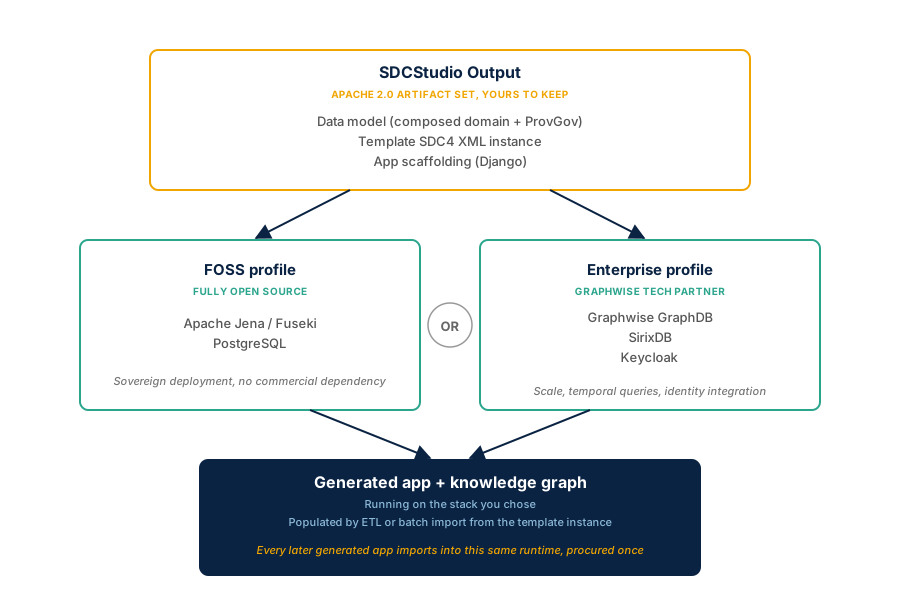
FOSS profile
Apache Jena and Fuseki for the triplestore and SPARQL endpoint, PostgreSQL for record storage. Fully open source.
Right fit for sovereign deployments without proprietary components, full source-level review, or a small footprint.
Enterprise profile
Graphwise GraphDB for large graph queries, SirixDB for time-travel storage of records, Keycloak for identity and access.
Right fit for scale targets, temporal queries, or existing identity infrastructure.
All generated code is Apache 2.0, with no commercial commitment to Axius SDC for what comes out. Every later app you generate imports into the first stack, so infrastructure is procured once.