Define it once
Most teams assume the modeling is the heavy work. For most domains the components already exist, most of them built from open standards, and they are free.
9,822 free public components
SDCStudio carries read-only public libraries that any model can reuse at no cost: 9,822 components on production when measured on 19 October 2026, 9,196 across the domain libraries below and 626 in the ProvGov layer. Most are built from an open standard and linked to the term it models. The list grows every few weeks.
We are modeling the open standards one by one, in public. The test is simple: if a standard can be modeled openly, it is an open standard, and it belongs here. Every component is published as it is done, at sdcstudio.axius-sdc.com, and readable without an account.
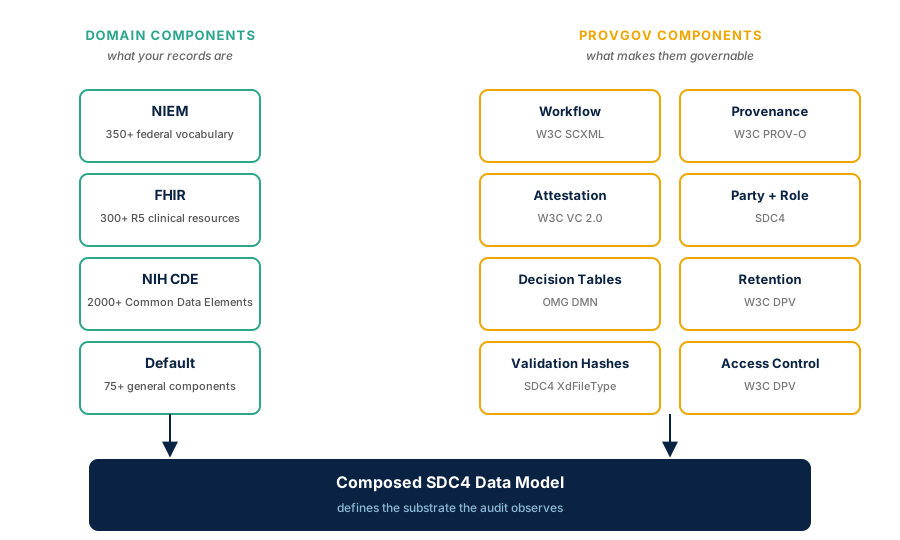
Domain libraries: what your records are
Counts measured on production on 15 October 2026 (FOCUS on 19 October). The libraries compose by slot, so one model can draw on several.
NIEM Foundation
1,603 components from the NIEM 6.0 model, Core and six domains
National Information Exchange Model. The federal interoperability vocabulary. State, local, and federal agencies and their downstream consumers already speak this language.
FHIR Clinical
321 components, FHIR R4 clinical resources
If you are in healthcare, your data already needs to map to FHIR. The library makes the mapping a reference, not a translation exercise.
NIH CDE
353 NIH-endorsed Common Data Elements
Research and clinical-trial work where instrument-level standardization matters. Sourced from the NIH portfolio.
Default Library
111 general components
General data structures: people, organizations, transactions, addresses, identifiers, common business entities. The starting point when no vertical library applies cleanly.
SINAN
2,459 components, Brazil's national notifiable-disease system, in Portuguese
Public-health surveillance notifications and investigations, built from the national data dictionaries, with Portuguese labels and descriptions for use in Brazil.
Business Documents
346 components, OASIS UBL 2.3 and GS1 identifiers; header and line records
The buy leg: Request for Quotation, Quotation, Order, Order Response, Despatch Advice, Receipt Advice, Invoice, Credit Note and Remittance Advice, each a header record and a line record chained by the document identifier, from which the UBL document is written and read.
Transport Documents
1,119 components, UBL 2.3 transport documents and UN/CEFACT eCMR
The ship leg: waybill, bill of lading, packing list, manifest, transport status and freight invoice, with the electronic bills of lading as models on the same components.
ISO 20022
1,342 components, payment initiation, interbank transfer, statements and remittance, as minimal records
The pay leg: pain.001 and pain.002, pacs.008 and pacs.002, camt.053 and camt.054, and remt.001, from the ISO 20022 e-Repository.
Traceability (GS1 EPCIS 2.0)
277 components, EPCIS 2.0 events and the Core Business Vocabulary, on the event's own grain
The five EPCIS event types and the FSMA 204 critical tracking events for food traceability, with the CBV lists as coded values.
Peppol
317 components, BIS Billing 3.0 and the ordering profiles
Peppol's Invoice, Credit Note, Order, Order Response and Despatch Advice, composed from the Business Documents components with the BIS rules as assertions.
UN/EDIFACT
81 components, the ISO 9735 interchange and the D.24A qualifier tokens
The interchange envelope as a Governed Data Record and the qualifier codes of ORDERS, ORDRSP, DESADV, RECADV, INVOIC and REMADV; the messages themselves are projections of the Business Documents records.
Imaging
213 components, medical imaging metadata anchored to DICOM tags
The record around an image: dataset, case, visit, study, one series record per modality family with its acquisition parameters by DICOM tag, annotations and the radiology report, chained by the natural keys. Not pixel data.
CRM
116 components, ten records: account, contact, lead, opportunity, opportunity product, activity, case, campaign, campaign membership, consent
The records every customer-relationship system captures, composed from the Default library. Every picklist is a published default vocabulary an organization copies and rebinds for its own stages, countries and languages (the definitions); consent is its own record on the W3C Data Privacy Vocabulary. The model is fixed; the vocabulary is yours.
ERP
102 components, eight records: customer, supplier, item, price list and its lines, location, inventory balance, employee
The master data an enterprise system keeps between transactions, on the Open Applications Group's nouns. A customer master carries the party, the payment terms and the CRM account by reference and copies nothing; the transactions themselves are the business documents already here (the vocabularies).
Ledger
29 components, three records: general ledger account, journal entry, journal entry line
The chart of accounts and the journal, element by element on XBRL Global Ledger: debit and credit as two amounts, the account's normal balance as a vocabulary, a balance as a query over posted lines rather than a stored number.
Human Resources
190 components, sixteen records: organizational unit, job, position, work assignment, pay grade, compensation element, absence, time entry, performance review, job requisition, candidate, application, benefit plan, benefit enrollment, learning record, competency
The organization's structure and the employment history as records, on HR Open Standards 4.5 by reference and the W3C Organization Ontology. The ERP employee stays the master; a promotion, a raise or a leave is a new record chained to it, never an overwritten field. Occupation and skill codes are coded values per scheme (the vocabularies).
FOCUS
189 components, thirteen records: charge, charge tag, contract application, allocation basis, commitment program eligibility, SKU price, billing period, contract commitment, commitment applicability rule, applicability rule value, invoice detail, delivery, time sector
Cloud, SaaS and AI billing as records, on the FinOps Open Cost and Usage Specification 1.4: every FOCUS column a component linked to its column page. Each charge has an identity of its own and names the delivery that asserted it; a correction is a new record naming the one it corrects, so the charge history is never overwritten (the vocabularies).
ProvGov components: what makes the records governable
The 626 ProvGov components carry governance evidence: who did what, when, under what authority, with what classification and with what tamper-evident hash chain. Each family is anchored to a public standard and layers onto your domain model. You need them for the optional governance track.
Workflow States
W3C SCXML
Ordered state machines: document lifecycle, record intake, incident response, regulatory filing.
Provenance
W3C PROV-O, Activity Streams 2.0
System identifier, activity type, start and end timestamps, location. Maps to SDC4 AuditType.
Attestation
W3C Verifiable Credentials 2.0
Authority assertion, proof, delegation scope, committed timestamp. Maps to SDC4 AttestationType.
Party and Role
SDC4 PartyType, ParticipationType
Identity, organization, participation function (authorizer, reviewer, subject, provider, processor), mode.
Decision Tables
OMG DMN
Risk score, classification, actor role, severity, legal hold. The condition inputs and outcomes the DMN engine reads.
Retention
W3C DPV
Most-recent + hash, last N records, or full chain. Plus retention justification for regulatory defensibility.
Validation Hashes
SDC4 XdFileType
SHA-256 entity-state-before and entity-state-after hashes. Make the provenance chain tamper-evident.
Access Control Tags
W3C DPV
Public, Internal, Restricted, Confidential classifications, plus consent-required and access-expiry signals.
How the two layers compose
Two ways to compose the model
sdcmodeler, from a terminal or an agent
pip install sdcmodeler. The modeler's client for SDCStudio: search the public catalog, get an estimate, then assemble and publish the model and generate its package, from the command line or from an agent over MCP (sdcmodeler mcp). Apache 2.0.
SDCStudio, in the browser
Log in, create a private project, reuse components by reference and model the rest. Domain experts can sketch first in SDCBench, a desktop canvas that needs no reference-model knowledge, and hand the draft to a modeler.
Three usage patterns
- Reference: pull a component into your model as it is. Alignment with the standard becomes a property of using the right component.
- Copy and modify: copy a component into your private project and extend it, when a public component is close and you need a local variation.
- Create custom: build from scratch, for what nothing in the libraries covers. Rarer than most teams expect.
The reuse syntax
Components are referenced inside a model in a Markdown-template style. Domain and ProvGov components use the same syntax:
Why reuse shrinks step 4
A component built from a standard carries that standard's term as a semantic link. When sdc-mapper writes the record into the same standard, those values are a lookup: no mapping rule is needed. The more of your model comes from the libraries, the smaller your declared count at day 30.
Most evaluations start without a single custom component: "we picked the components on Monday and the agent had records by Tuesday."
What it costs
Reusing a published component costs nothing. Minting a new one is 100 credits, and assembling the model is 500 credits plus its mints; credits are bought in advance at 1,000 per US dollar. Searching the catalog and getting an estimate need no account. Most evaluations spend fewer than 20,000 credits ($20 worth).